This article was originally published in Spanish by Mongabay.
- In the A’i Cofán community of Sinangoe, the Indigenous Guard’s youth learning initiative, known as Chipiri Kuirasunde’khu — Little Defenders of the Forest — was established.
- The guard is made up of 47 children between the ages of three and fifteen and seeks to revitalize their mother tongue and cultural practices through direct contact with their territory.
- The initiative also aims to nurture future leaders who will protect the 64,000 hectares of Amazon rainforest from threats such as illegal mining and unconsulted concessions.
- It is part of a community-led education model — an approach grounded in a constitutional right that has yet to be officially recognized — and was conceived by a 12-year-old girl who now coordinates the initiative.
A 15-minute walk from the Sinangoe community center in the Ecuadorian Amazon lies the Segueyo River. Emerald in color and calm in its flow, it runs quietly past the forest. Along its banks, about 50 children from the Indigenous children’s guard Chipiri Kuirasunde’khu sat around a fire listening to stories.
“That’s what remains of the fish tree,” says 12-year-old Melany Guaramag. She is referring to a myth that recounts the origin of the A’i Cofán people and the abundance of fish that once filled these waters. Melany is the coordinator of the Chipiri Kuirasunde’khu — a name in A’ingae that means “Little Guardians of the Forest.”
Elder Graciela Quenamá told the story in her mother tongue. “Grandparents carry the responsibility of teaching where our roots come from, so that children grow up knowing we must remain A’i Cofán,” explains Érika Narváez, a member of the community’s adult guard who coordinates the children’s guard activities.
Guaramag had occasionally accompanied the adult Indigenous guard when she proposed creating a group for boys and girls. She spoke with Alexandra Narváez — recognized for receiving the Goldman Environmental Prize in 2022 — who had initially faced resistance from her own community when she sought to become the first woman to serve as a guardian of their territory.
“I told her we could create another group — a youth learning initiative,” the girl recalls. This time, the idea was warmly received by the community from the outset. A territorial assessment had revealed that the culture and language were being lost, along with the knowledge that has enabled them to conserve nearly 64,000 hectares of Amazon rainforest. After discussions in the community assembly, a consensus was reached for the adult guard to lead the process.
They designed the methodology, and parents approved it. “On February 7, 2025, we began walking with the Chipiri,” Alexandra Narváez recounts. “We walked through the territory, played, and listened to the elders’ stories around a fire — it was a very beautiful first gathering,” she adds.

The creation of the Indigenous Guard’s youth initiative is closely tied to Sinangoe’s community-led education project. “We want education to extend beyond four walls, as established by the Ministry,” says Wider Guaramag, president of the community. For the A’i Cofán, he explains, learning must take place throughout the territory and follow their own pedagogy — learning by doing, through lived experience.
Language: A Tool for Keeping Culture Alive
For the camp in Segueyo, the children requested tents and hammocks from the adult guard. They packed food into their backpacks and pulled on their rubber boots. At four in the morning, they gathered at the medicine house, where the elders prepared yokó, a natural energizing drink. “As we drink it, we reflect on what we are going to do, what we might encounter in the forest, whether there will be dangers or not,” explains Érika Narváez.
They set out for Segueyo in the afternoon. Upon arrival, they cooled off in the river and pitched their tents. Together they prepared the meal and ate as the elders shared stories.
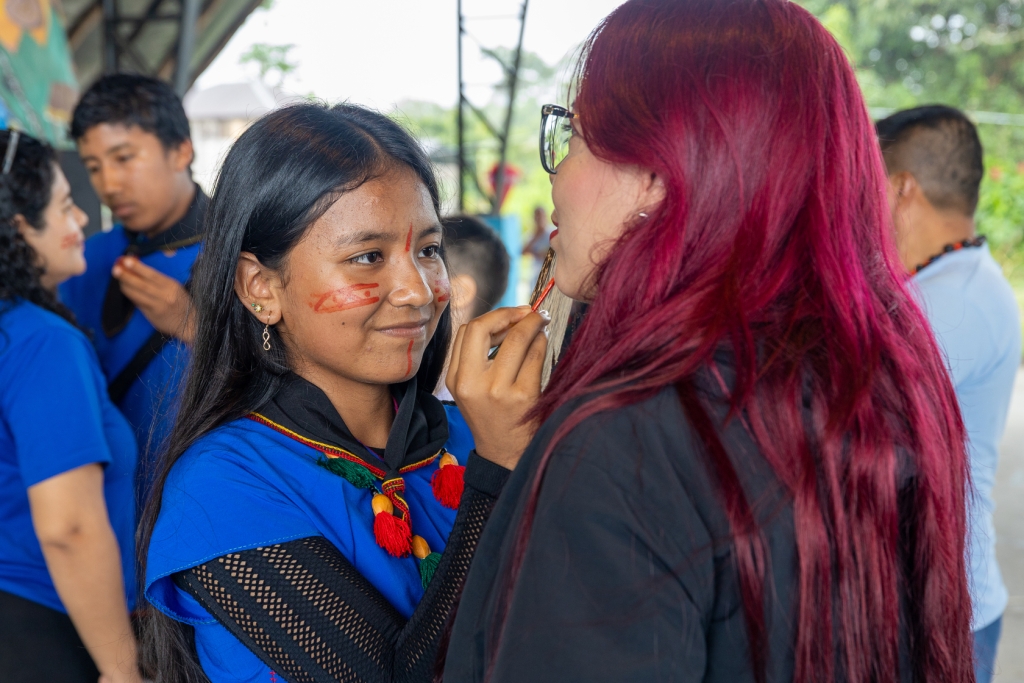
The next day, they woke at dawn and began with exercise. Afterwards, they walked through the forest in search of medicinal plants. Melany’s group found yokó, the plant whose root is ritually prepared and consumed at daybreak. “We saw how it’s cut, how it’s harvested, and how to tell when it’s ready,” she explains.
The group is made up of 47 children between the ages of three and fifteen. They are divided into three age groups: three to seven, eight to eleven, and twelve to fifteen. Members of the adult guard, community elders, and some parents support them during these activities.
“This year, as we’ve been teaching, the children have already begun speaking the language again, because it was being lost,” says Érika Narváez. Grandmother Graciela does not speak Spanish, so children who want to talk with her and listen to her stories must learn their language. In the meantime, Narváez serves as interpreter.

“I speak a few words with my father at home, but I don’t understand very well,” Melany Guaramag admits. Still, she doesn’t get discouraged. “Sometimes the stories are told in A’ingae, and I understand more or less. If I don’t, I ask my classmates to translate for me,” she says.
Speaking their mother tongue is essential to understanding their culture, ancestral knowledge, and territory, according to Érika Narváez. “We teach children to build a connection with the territory and to protect it. It is possible for them to learn how to keep it alive — because if it disappears, we will no longer be A’i Cofán,” she explains.
Elders as the Foundation of Education
The assessment also found that younger generations were losing cultural practices related to food sovereignty and health, says Patricia Peñaherrera, the Education Program Lead at Amazon Frontlines and technical advisor to Sinangoe. For her, institutionalized education separates Indigenous peoples from their families, their territory, and their community.

When reviewing the national curriculum framework — particularly the Intercultural Bilingual Education System Model (MOSEIB) — members of Sinangoe identified themes that did not align with their reality. “It’s very Andean and not in tune with our Amazon,” says Wider Guaramag. For example, educational materials included texts and images of medicinal plants from the highlands, rather than encouraging students to learn about their own environment.
In response, they worked to develop their own curriculum proposal. “In terms of themes and content, priority has been given to the territory, to the elders’ work in caring for nature, and to the community’s historical process of struggle and resistance,” explains Peñaherrera. They also incorporated topics related to local ecosystems and biodiversity.
The people of Sinangoe are river people, and caring for the water is deeply important to them, so an entire chapter is devoted to it, she adds. It explores the origin of water from the A’i Cofán worldview, while also addressing scientific knowledge, such as the chemical structure of water.

Now, elders visit the school to teach skills such as weaving baskets and cast nets — objects central to their culture. Wider Guaramag explains that these activities help integrate different forms of knowledge.
To weave a basket, lessons begin with natural sciences and strengthen the connection to the territory by reflecting on — and even seeking out — the origin of the plant fibers. As children learn to weave, the elders share related myths and legends, covering social studies. Mathematical knowledge is also incorporated, as students recognize geometric patterns within the weaving.
Another change involved language. Although the MOSEIB includes a subject dedicated to the mother tongue, members of Sinangoe believe A’ingae should run through the entire learning process and be present in all subjects. “It is about safeguarding the cultural identity of the territory,” says Guaramag.
A March for Self-Determined Education

Members of the community, along with representatives of the Waorani of Pastaza and the Siekopai peoples, marched in Quito on January 20 to demand that the Ministry of Education formally register their community-led education projects. Although this is a constitutional right, it has yet to receive official recognition.
Later that afternoon, the delegations met with José Luis Torres, Vice Minister of Education; José Atupaña, Secretary of Intercultural Bilingual Education and Ethnoeducation; and Ángela Tipán, General Undersecretary of the Office of the Vice President of the Republic.
Leaders from the three Indigenous nations presented the projects already being implemented in their territories. The authorities committed to reviewing the proposals, providing feedback, and developing a roadmap toward formal registration. A follow-up meeting with technical teams is tentatively scheduled for February 24.

“We have been very careful with this process. That is why we developed it alongside our technical team, and we hope there will be no obstacles,” says Guaramag. The project has been implemented in Sinangoe for one year and has been in development for two. The Waorani have been implementing their model for six years, and the Siekopai for nearly three.
Sinangoe, however, has not had positive experiences with the Ministry of Education. In 2018, regressive erosion from the Aguarico River caused the school to collapse. Since then, children have attended classes in storage buildings, a communal house, and a space built by the community. In 2024, a court ordered the State to present, within 60 days, a timeline for rebuilding the school, but authorities reportedly acknowledged they lacked funds for the project, according to Guaramag.
Caring for the Territory: A Responsibility Shared by Even the Youngest
Alongside the development of their own curriculum, Sinangoe created a community-led education project. “We need to return to living as A’i Cofán,” says the community president. Since colonization and evangelization, traditional practices have been replaced by Western customs.

For example, he says, elders want to strengthen young people’s connection to the territory so they do not fall into illegal mining networks — an activity threatening the community — nor become divided by promises of economic benefits from unconsulted mining concessions, as has already happened in other Indigenous communities.
“If we fail to raise these children to be strong in this sense today, we will lose our territory, we will lose our rights, we will lose practically everything,” Guaramag affirms.
The community-led education project and the Chipiri Kuirasunde’khu guard form the foundations the people of Sinangoe are working to strengthen for future generations. “Caring for the territory’s shared resources has increasingly become a responsibility for everyone — not just a specialized body that conducts patrols,” says Peñaherrera.
Indeed, the children’s guard aims to raise boys and girls who know the forest and their culture, who have a voice of their own, and who grow into future leaders.

Joining the adult guard — the group responsible for keeping environmental threats at bay and which has already won a legal ruling against unconsulted concessions affecting Sinangoe — is voluntary, the community president explains. Once young people turn 15, they may decide whether to join this collective of men, women, youth, and elders.
Being part of the Indigenous Guard youth initiative has inspired Melany to continue learning about the forest and the rivers her ancestors have depended on. “It has given me an even stronger desire to care for my territory, because it is life; we have plants, medicine, fruits, animals, fish, clean water, oxygen — we have everything,” she says.
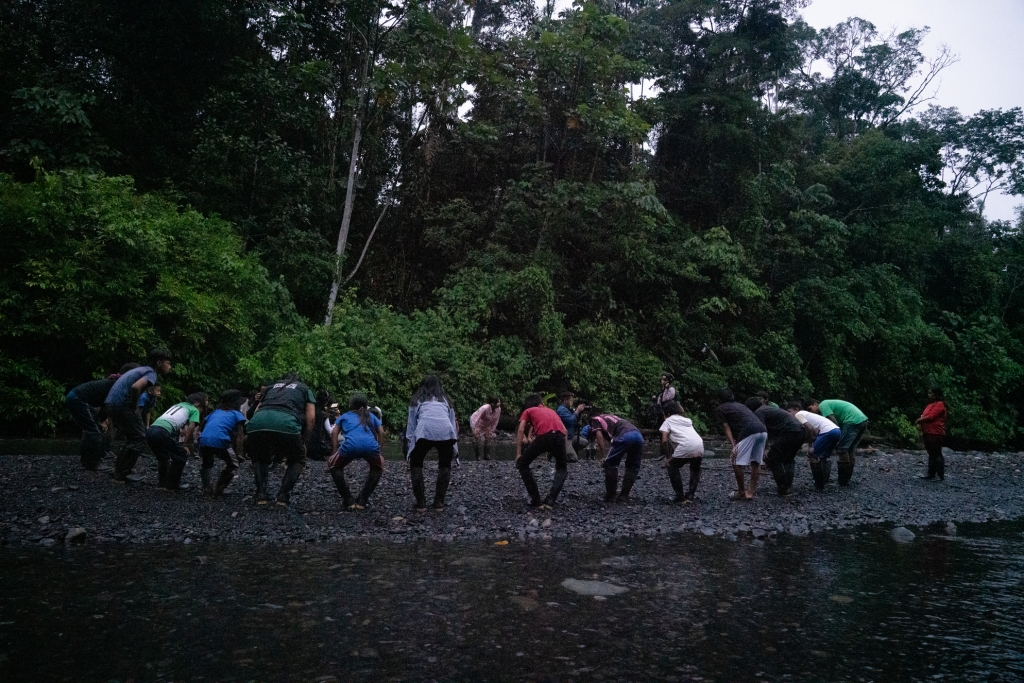
Main photo: Children who are part of the Indigenous guard youth learning initiative participate in a drone training exercise, a technology used by the Sinangoe A’i Cofán Indigenous guard to monitor threats to their territory. Photo: Courtesy of Morelia Mendúa / Alianza Ceibo.