This article was originally published in Spanish by Mongabay.
Key points:
- Indigenous Guards from villages in Colombia, Ecuador, and Peru gathered in the A’i Cofán community of Sinangoe, in the northern Ecuadorian Amazon.
- At the meeting, they exchanged knowledge and wisdom with elders to strengthen the identity and protection of the Amazon.
- A central focus was the analysis of threats, such as the expansion of oil and mining, as well as illicit activities that occur throughout Indigenous territories.
- After five days of work, participants created a statement that seeks to empower the work of Indigenous Guards as rights defenders.
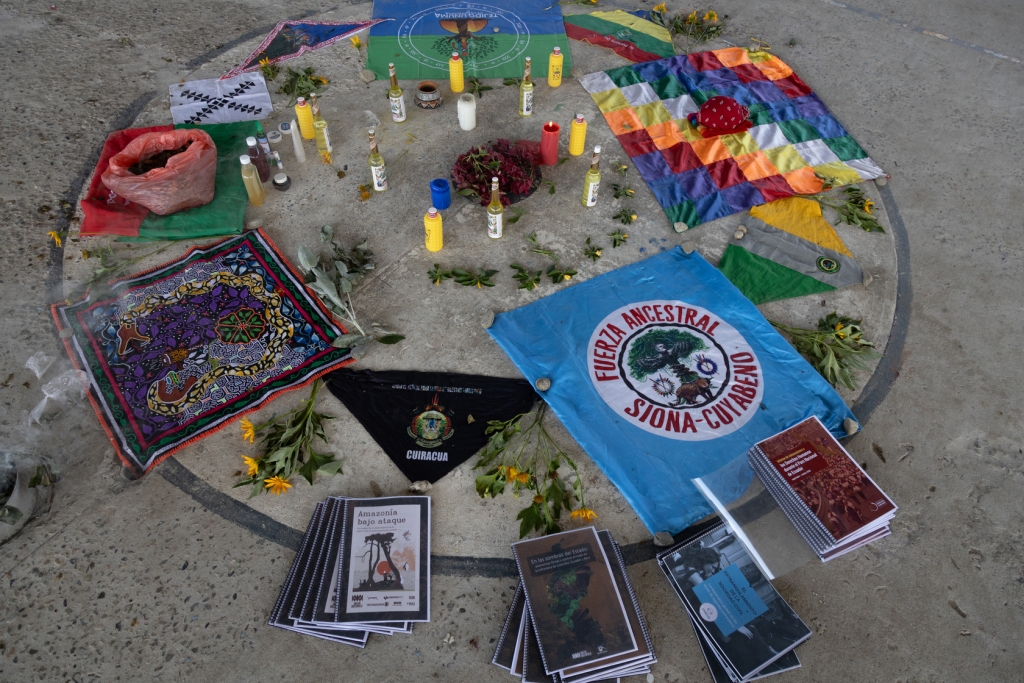
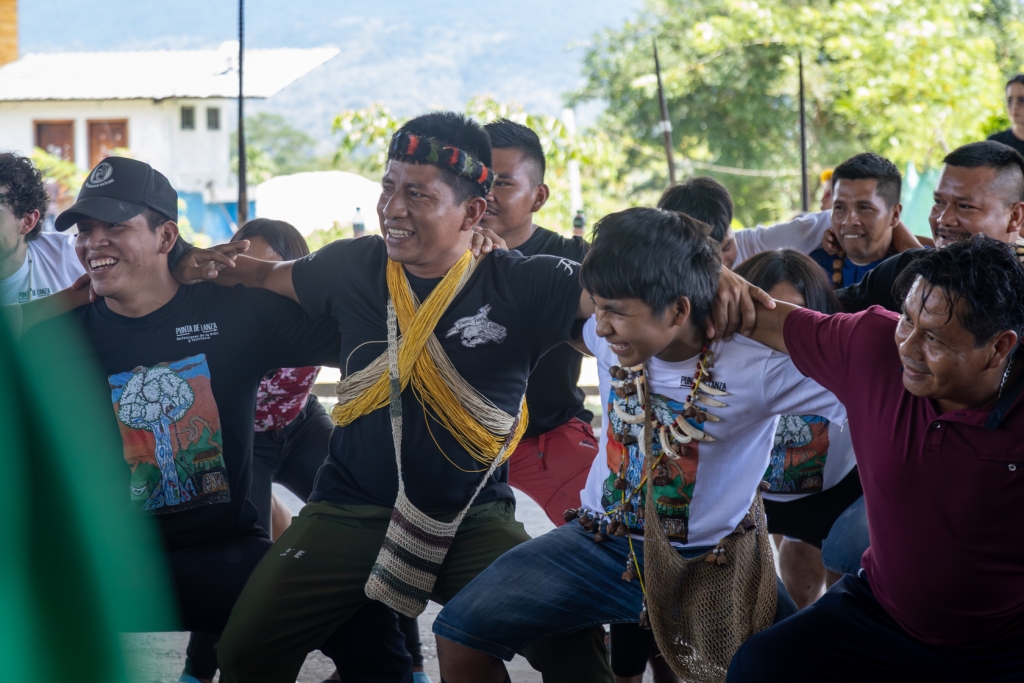
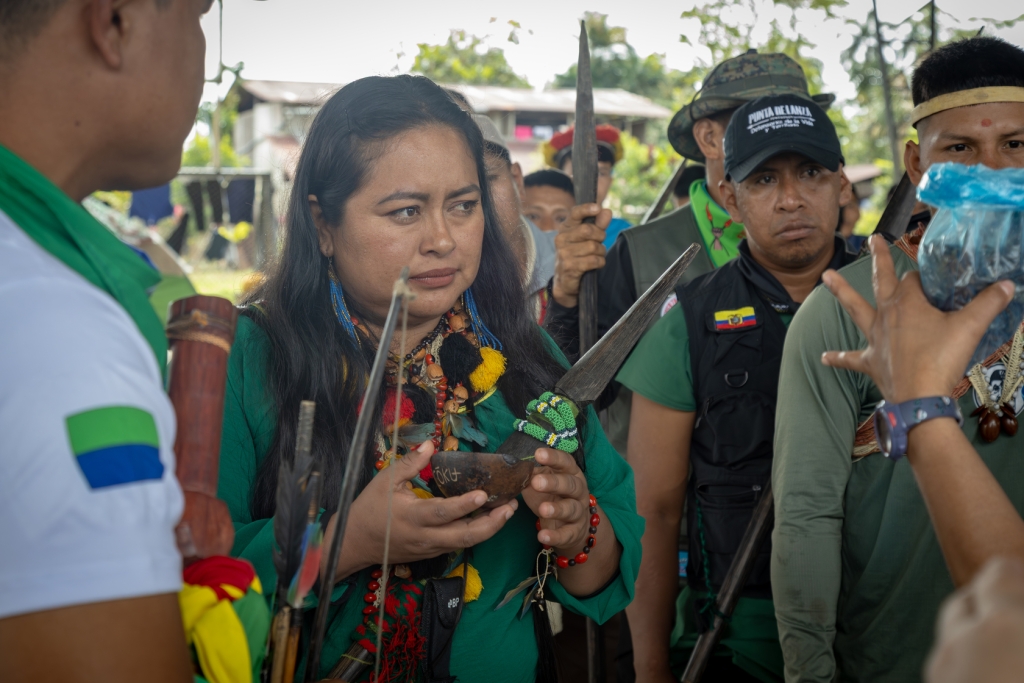
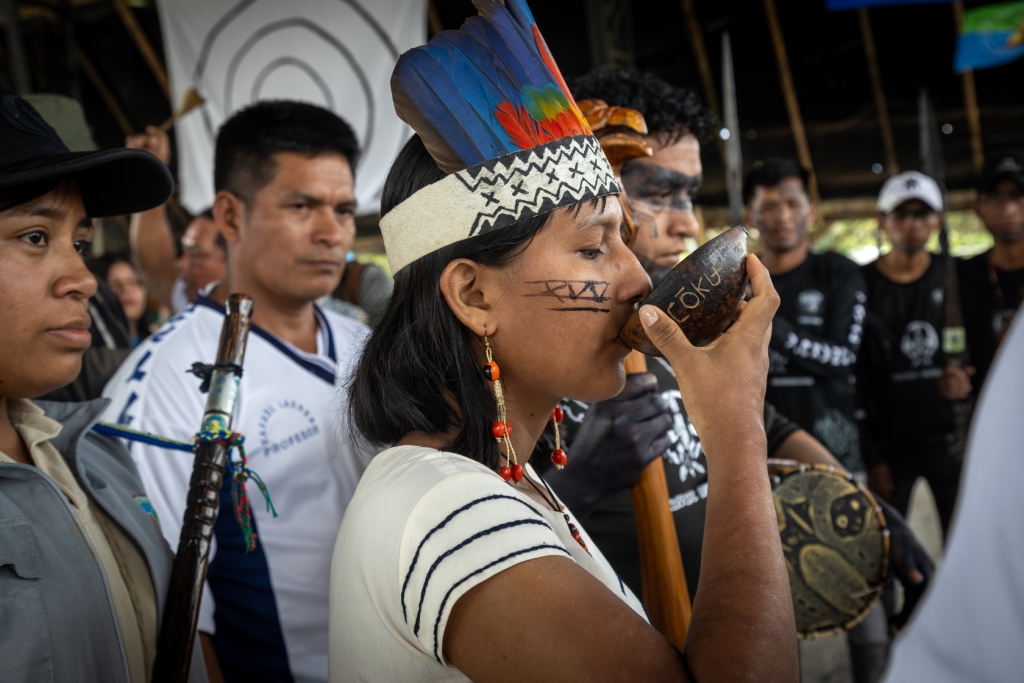
They came with spears in their hands, feather headdresses, and chambira weavings. More than 200 people from 15 villages of the Colombian, Ecuadorian, and Peruvian Amazon crossed forests and navigated the Aguarico River, in northern Ecuador, until they reached the A’i Cofán community of Sinangoe. There, from December 1 to 5, 2025, they participated in the Meeting of Indigenous Guards to Share Experiences and Knowledge for the Defense of Territory and Culture.
“We have come together to exchange insights that arise from our worldviews and from the spirituality of each territory, to revive the memories and struggles of the Peoples who have been persevering here for so long,” Alexandra Narváez, an A’i Cofán leader, told Mongabay Latam during the second day of the meeting. “The Indigenous Guards here are protectors of life,” she emphasized.
That morning, the traditional authorities of the Shuar people cleansed the attendees with nettles, a spiritual and healing tradition. In the space designated for harmonization, Shuar leader Josefina Tunki shared tobacco. Tobacco is considered sacred and is used for healing, cleansing, and establishing spiritual communication.
The Punta de Lanza (Spearhead) team is comprised of Narváez, Robert Molina (former Coordinator of the Indigenous Guard of the Regional Indigenous Council of Cauca, Colombia) and Mario Erazo (leader of the Ziobain Indigenous People, from the Colombian border with Ecuador). The team is supported by the non-governmental organization Amazon Frontlines and the Ceibo Alliance, which organized the meeting.
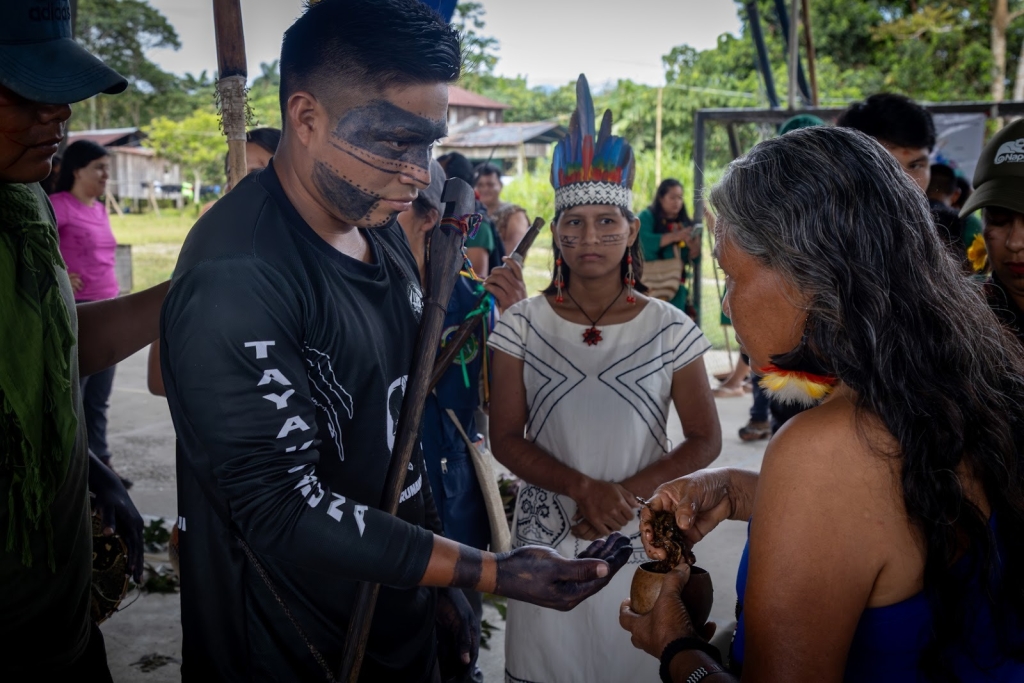
Punta de Lanza was founded in 2022 following the first meeting of Indigenous Guards in Ecuador. Its objective is to strengthen these unarmed civilian groups, who are organized in defense of the rights of Indigenous Peoples and Nations against the encroachment of extractive industries and illicit commercial activity in their territories.
“The great task before us is for the elders to transmit knowledge, and for the young people to absorb it. For our starting points, we must look to spirituality and to principles; that is our bulletproof vest,” Erazo, who traveled from the community of Buenavista, said to the attendees.
Over the course of five days, participants presented and discussed connections between their worldviews, territories, and spirituality, and the importance of their language and culture in ensuring their survival as Indigenous Peoples. They also worked on strengthening organizational capacity, autonomy, and territorial defense.
Cross-border communities at risk
The third day focused on analyzing the current threats to Indigenous Peoples. To start with, at least 67% of the 987 municipalities in Bolivia, Brazil, Colombia, Ecuador, Peru, and Venezuela are forced to deal with the presence of criminal networks and armed groups associated with illegal gold mining and drug trafficking, according to the investigation “Amazon Under Attack,” published in October 2025 by the media alliance Amazon Underworld.
Furthermore, oil and gas blocks have been imposed upon 31 million hectares of Indigenous territories across the Amazon basin, according to an analysis published in November 2025 by the organization Earth Insight. The research also identified 9.8 million hectares of mining concessions on ancestral Amazonian territories.
María Espinosa, a lawyer with the organization Amazon Frontlines, identified a third category of threat: the regulatory changes taking place in Colombia, Ecuador, and Peru which “have the objective” of leaving Indigenous Peoples “without collective rights.”
The Kakataibo Indigenous People in the Peruvian Amazon face problems introduced into their territories by both the State and illegal actors. Elías Noico, a member of the Kakataibo Indigenous Guard, noted that it is the State itself that grants mining and logging rights within Indigenous territories.
Moreover, the Kakataibo People live between the Ucayali and Huánuco regions, two of the deadliest for Indigenous peoples in Peru, according to the Mongabay Latam investigation, “Flights of Death.“ During the meeting, Noico stated that the presence of clandestine airstrips used for drug trafficking and land grabs is endangering the lives of Indigenous leaders and guards.
At least six members of the Kakataibo People have been killed in this context, Noico told Mongabay Latam. He himself has received death threats and, although the State has granted him legal “protections,” he does not trust them because they are nothing more than documents that “can’t stop bullets.”
As a protective measure, Indigenous Guards from various communities have joined forces to try to keep invaders and illicit actors out. Noico also proposed regional integration to strengthen communities against threatening forces that, in his view, seek to deprive them of their ancestral rights.
In Ecuador, more and more Indigenous communities are threatened by the expansion of illegal gold mining. Jacinto Shiguango is a member of the Inkarukunas, the Indigenous Guard of the Kichwa People of Rukullacta (known as PKR, Pueblo Kichwa de Rukullacta). He told Mongabay Latam that outsiders arrived and got PKR residents involved in illegal mining activities.
In a collective assembly, the community decided to evict the illegal miners. However, before the Indigenous Guard could act with support from the rest of the population, the miners withdrew to avoid a confrontation. Since then, Shiguango says, the Indigenous Guard has remained vigilant in defending the territory.
The right to territory, violated
María Ochoa, a representative of the Murui Bue people, offered another example illustrating attempts to violate the rights of Indigenous People. She explained that although the Murui territory is legally titled, the Peruvian state recognizes only the Murui Muinani, ignoring the different communities within this main group. This lack of recognition, she told Mongabay Latam,hinders the validation of their rights.
Right now, the Murui Bue people are facing attempts by the Peruvian government to build the second section of the Bellavista-Mazán-Salvador-El Estrecho highway through the community of Centro Arenal, despite a lack of prior, free, and informed consultation. “They don’t realize how severely it will affect us environmentally, culturally, socially – even our birds will be impacted. Why can’t the government understand that it is causing us psychological harm as well?” Ochoa asked.
Together with an anthropologist from an organization called Rights, Environment, and Natural Resources (DAR – Derechos, Ambiente, y Recursos Naturales), the Murui Bue people learned about their rights and created “talking maps” of their territory. Such maps are a representation that captures cultural, environmental, economic, and social perceptions of spaces through graphics and the use of indigenous languages.
Many of the participants at the Meeting noted that this type of exercise helps Indigenous People, as guardians of their territories, to more clearly demonstrate their connection to the space they have ancestrally inhabited. The Guards, in particular, play a special role, as they are the ones who constantly monitor the territory and are often the first to recognize any changes or threats.
Finally, the Ministry of Transport and Communications initiated a consultation process. Ochoa points out, however, that the institution has justified delays and other errors in the process by claiming that this would be the first time it has conducted a consultation of this kind. The community of Centro Arenal developed its own Prior Consultation Protocol so that the consultation would not be a purely administrative process, but rather one that truly seeks the informed consent of the Indigenous population.
In Ecuador, an environmental consultation is currently underway that would pave the way for oil exploitation in Block 10. Despite the presence of Indigenous populations, there has been no process for a prior, free, and informed consultation, which has higher standards than an environmental consultation. According to Espinosa, the higher standard not only seeks to inform about the execution of an activity and its impacts, but also to avoid putting at risk the right to cultural existence linked to the territory.
Striving for autonomous government
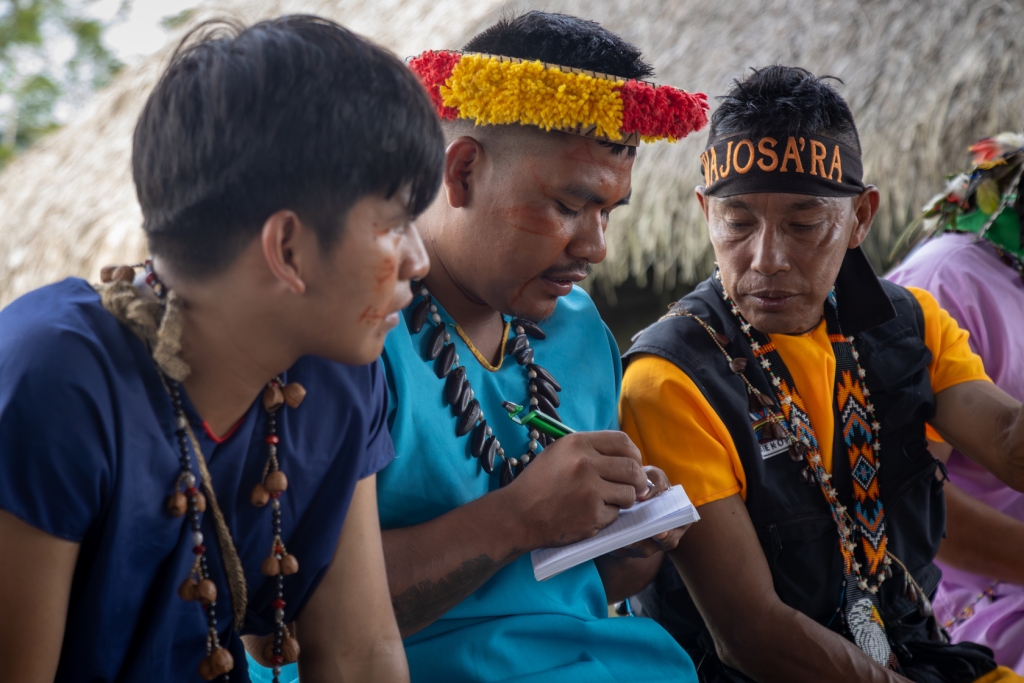
In light of these problems, attorney Espinosa reminded attendees that all three countries recognize the right of Indigenous Peoples to exercise jurisdiction over their territories. “You are the territorial authority,” she said. While Indigenous Peoples and communities face obstacles in gaining recognition for themselves, their territories, and their rights, Espinosa encouraged them to continue strengthening autonomous governance through the development of collective statutes.
On the fourth day of the meeting, participants analyzed successful experiences in autonomous management, governance, and territorial defense. They also considered present-day realities and the contributions of the Indigenous Guards. On the final day, the Meeting’s pronouncement document was approved.
The pronouncement addressed criminalization faced by Indigenous Guards, as occurred recently in Ecuador following the national strike in October. “This attempt to discredit our identity and our work as a collective subject of rights, by trying to align us with terrorism or drug trafficking, creates a scenario of grave risk to our safety and our culture,” the document states.
“The Guard needs nothing more than collective permission. The Guard may unsettle the powers that be, because it is a line of defense for territories and for life,” Espinosa asserted.
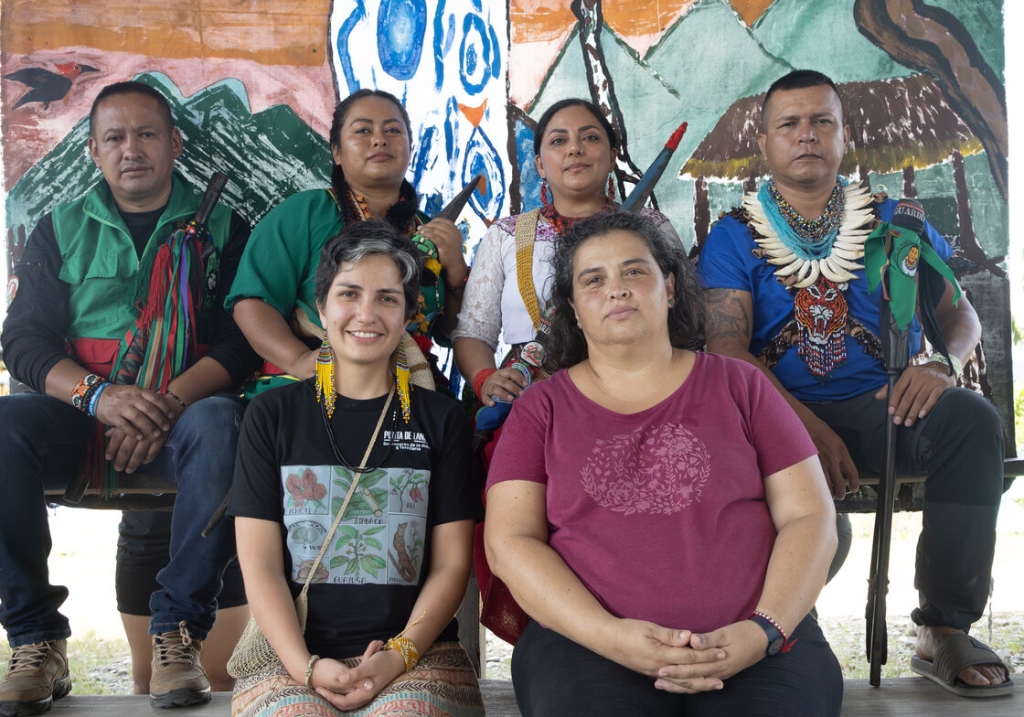
The 15 communities resolved to reaffirm autonomous governance, Indigenous jurisdiction, and the Indigenous Guards as an exercise of the collective rights recognized in each of the three countries and under international norms. They also resolved to reaffirm the coordination of Indigenous Guards at the regional level and to recognize their work as defenders of life and territory. Finally, they reiterated to the national governments that they will continue to carry out actions of monitoring, control, and governance.
In the second part of the document, they demanded that the States guarantee the security and integrity of the territories against illicit threats, provide guarantees to protect the Indigenous Guards, and cease political persecution of defenders of human rights, nature, and collective rights.
The pronouncement was signed by representatives of the Amazonian Peoples Ziobaín, Awá, A’i Cofán, Siekopai, Kichwa of Rukullacta and Kichwa of Pastaza, Quijos, Waorani, Shuar, Kakataibo, Kukama, Murui Bue, Shipibo Konibo Shetebo, and by the Indigenous Guards that make up the Unuma Network of the Colombian Orinoco Region and the Regional Indigenous Council of Cauca.
On Friday at noon, the delegations crossed the Aguarico River once more. They returned to territories that are increasingly besieged by illicit interests while simultaneously facing State neglect.
Main photo: Representatives of 15 Indigenous Peoples from Colombia, Ecuador, and Peru attended the Meeting of Indigenous Guards. Photo courtesy of Daris Payaguaje / Ceibo Alliance.