Below is the full text of the statement issued by the Siekopaai Nation.
- The Court must prioritize our case by scheduling a hearing and overturning this non-compliance, which is prolonging the serious violation of our rights.
- The Ministry of the Environment must comply with the ruling ,including issuing our title to the territory immediately.
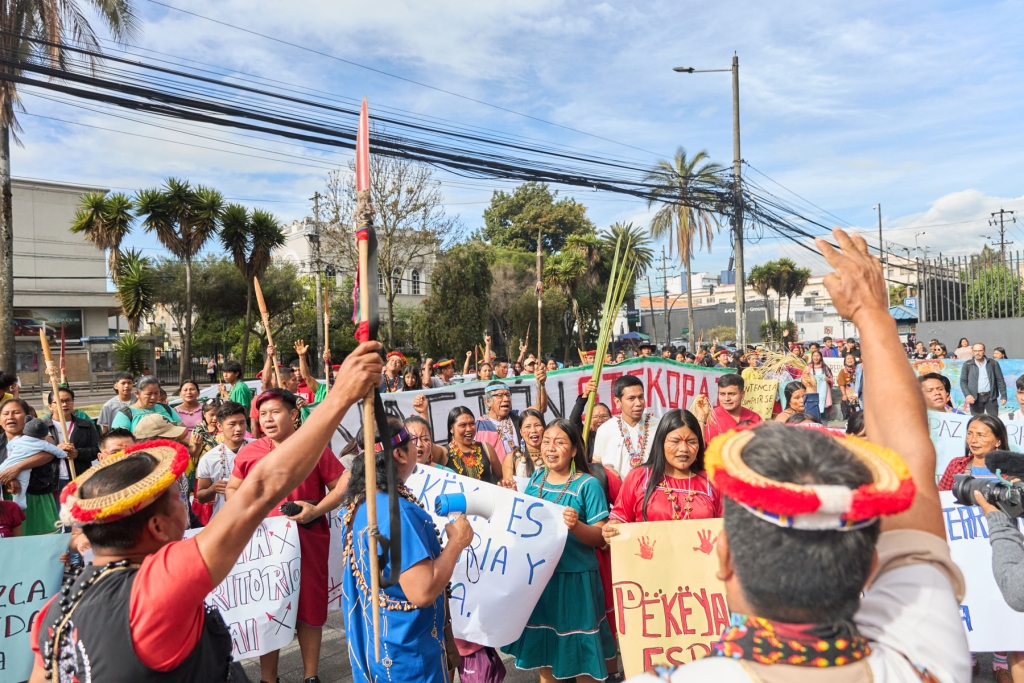
Quito, June 24, 2026. – Nearly 200 Indigenous people from the Siekopaai Nation arrived in the capital to demand the Constitutional Court of Ecuador (CCE) and the Ministry of Environment and Energy immediately enforce the ruling of the Provincial Court of Sucumbíos, which ordered 943 days ago that we receive the title to the ancestral territory of Pë’këya, our “spiritual heart.”
“We are here precisely to demand our rights and ensure the compliance of the title to the ancestral territory of Pëkëya,” said Eder Payaguaje, president of the Siekopaai Nation, during a press conference held hours before 70 representatives were received by CCE’s advisors, who said our demands will be reported to the judges and thereby prioritize our case.
Later, a delegation of eight leaders attended a meeting at the Ministry of Environment and Energy. In discussions with the team of the Assistant Secretary of Cultural Heritage, we expressed our concerns about the failure to comply with the ruling for more than two years.
“We proposed an ongoing dialogue to ensure this ruling is enforced.. And we will coordinate a new date to discuss the next steps we will begin working on,” said Justino Piaguaje, Territorial Leader of the Siekopaai Nation.
“We emphasized to the Ministry of the Environment the urgency and necessity of this institution to comply with its obligation to issue the title to the territory and an apology. The Ministry indicated that it does indeed intend to comply. It acknowledged that it has not yet done so, but that it will take the necessary steps to ensure that the obligations established by the ruling are fulfilled,” said Jorge Acero, a lawyer and human rights defender.
A historic ruling has been ignored for nearly 1,000 days
In 2022, we filed a protective action against the then-Ministry of Environment, Water, and Ecological Transition to secure the title to the territory of Pëkëya. A year later, on November 24, 2023, we obtained a historic ruling ordering the title of 42,360 hectares within our indigenous territory. This ruling addresses decades of dispossession, acknowledges our ancestral ownership, and affirms the violation of our rights.
The Ecuadorian government has refused to comply with a ruling that orders, for the first time in the country, the titling of an ancestral Indigenous territory within a protected area—a right recognized in the Constitution. Our case is currently before the Constitutional Court, which must address the failure to comply with the judicial reparations established by the ruling.
“A constitutional proceeding in which a violation of rights is established does not conclude until the ruling is enforced and the violation has been overturned; that is the objective of constitutional justice. That is why we are turning to the Constitutional Court to urgently rule on this non-compliance and ensure that the reparations established for the violation of the Siekopai Nationality’s rights are enforced. The court ultimately bears a responsibility—not only toward this nationality, which is at clear risk of cultural extinction, but also toward the peoples and nationalities of the country—to deliver justice and to truly ensure that these collective rights are respected and guaranteed,” explained Jorge Acero.
“Ecuador is a megadiverse country; it is a plurinational state, an intercultural state, and that must be acknowledged. The way to guarantee and bring to life a plurinational and intercultural state is by safeguarding the territories of indigenous peoples. We cannot live amid social, cultural, and economic divides. We are all called to live together in peace,” stated Justino Piaguaje.
“This territory is important because it represents our identity, our worldview, and our culture. It is important for young people to return, to reconnect, and to live once again on this land where our grandparents lived and connected with the spirits of the jungle. That is why I want my children—and the children of future generations of the Siekopaai Nation—to walk freely on this territory, to reconnect with the spirits, and to live once again as our grandparents did. Above all, I want them to know the origins of this great Siekopaai Nation,” explained Consuelo Piaguaje, a young leader.
85 years of surviving cultural erasure
Our Siekopaai Nation has survived nearly a century of violence, from the rubber boom and religious missions to the forced displacement caused by the 1941 war between Ecuador and Peru. After the war ended, our people were divided, expelled, and condemned to disappear. The establishment of military outposts and the creation—without consultation—of the Cuyabeno Wildlife Reserve in 1979, which was expanded in 1991, perpetuated the dispossession of our people of their territory. We have been fighting for 85 years for the cultural, spiritual, and physical survival of our nation, which today numbers no more than 800 people in Ecuador and 1,200 in Peru.
“Thanks to the struggle and persistence of the Siekopaai Nation, we are still here alive, speaking our own language, and living in our territory. But we would also like to live in the Ecuadorian state with the legal certainty that the state must guarantee us. We cannot spend another 500 years demanding guarantees for our territories to ensure our physical and cultural survival,” reflected Justino Piaguaje.
We demand:
- The Constitutional Court: To rule on the case and ensure effective enforcement of the ruling.
- The Ministry of Environment and Energy: To comply with the ruling in the Siekopaai Case (Case No. 21332-2022-00699) without further delay.
Press contacts:
- Ribaldo Piaguaje – Siekopaai Nation, +593 93 990 5665
- Luisana Aguilar – Amazon Frontlines, luisana@amazonfrontlines.org
Audiovisual material from the day; please provide the appropriate credits: